

By Torah law (d'oraita), any clean utensil, countertop, etc., automatically reverts to neutral/pareve and kosher after not being heated to more than 120° F (49° C) for 24 hours.
But by rabbinic decree, utensils do not automatically become neutral/pareve even after 24 hours and must be kashered by heat (libun—direct heat; hag'ala—boiling in a pot; or eruy rotchim—pouring boiling water over item) or, if some types of glass, by soaking in water (meluy v'eruy ).
Changing Gender of Utensil
You may kasher a pot or cooking/eating utensil from:
- Non-kosher to kosher, or
- Year-round use (chametz) to kosher for Passover.
You may not intentionally kasher a utensil in order to change it from dairy to meat or meat to dairy; you must first kasher it from accidentally (or intentionally) non-kosher to kosher/pareve, or from non-Passover to Passover/pareve. You may then use it for either dairy or meat.
Once you have used it for that gender, the item retains that gender (unless you re-kasher it for Passover or you make it non-kosher first, then kasher it to neutral/pareve).
But if you accidentally heat meat with a dairy utensil or vice versa, you may kasher it back to its original gender by any one of the kashering methods, depending on how it became non-kosher.
Items/Materials that Can Be Kashered
The following materials can be kashered:
- Glass, including Corelle, if not used directly on the stove or oven. Glass does not change gender or other kosher status unless heated on a flame or in the oven. Unless it is heated in this way, glass does not ever need to be kashered (except for Passover) (see Meluy v'Eruy, below).Glass, including Corelle, if not used directly on the stove or oven. Glass does not change gender or other kosher status unless heated on a flame or in the oven. Unless it is heated in this way, glass does not ever need to be kashered (except for Passover) (see Meluy v'Eruy, below).Glass, including Corelle, if not used directly on the stove or oven. Glass does not change gender or other kosher status unless heated on a flame or in the oven. Unless it is heated in this way, glass does not ever need to be kashered (except for Passover) (see Meluy v'Eruy, below).
be kashered except by heating in a kiln.
- Granite (not granite composite)
- Marble
- Wood, if smooth (see notes on Eruy Rotchim, below)
- Metal, including stainless steel, cast iron, and aluminum.
Items/Materials that Cannot Be Kashered
- China
- Corian
- Corningware
- Crockpot
- Formica
- Glass that has been used directly (kli rishon) on a stove or in an oven; however it can be kashered in a kiln
- Granite (composite)
- Knives with Plastic Handles (knives with wooden handles may be kashered if there are no cracks in the wood and if the rivets do not have spaces that catch food and prevent you from cleaning it completely)
- Mixer-there might be exceptions. Consult a rabbi.
- Plastic
- Porcelain (Enamel)
- Pyrex (if used directly on stove or in oven--kli rishon)
- Rubber (synthetic)
- Silestone
- Silverstone
- Stoneware
- Teflon
- Toaster/Toaster Oven
- Waffle Iron.
Pot Lid Handle
Kashering
The handle on a pot lid does not need to be kashered for normal use during the year.
Reason It does not normally get hot.
Cleaning
However, the pot lid handle must be removed and the lid cleaned where the handle attaches, if possible.
Note If the gap between the handle and lid cannot be completely cleaned, you may not use that lid for Passover and you normally may not kasher it if it becomes non-kosher. If the lid handle cannot be removed, consult a rabbi.
Pot or Pan Handle
A plastic handle that gets hot, especially if it is over a flame on a burner, may not be kashered. If the handle becomes non-kosher, it must be replaced. If a plastic handle connects directly to the metal of the utensil, consult a rabbi about what to do.
Food Nullification: Heat-Kashering
Three Methods of Heat-Kashering
Heat-Kashering is of three types: Libun, Hag'ala, and Eruy Rotchim.
-
Libun (Direct Heat)
How It Works Burns up any residual food taste
- Direct a flame, such as a blowtorch, onto the inside of a pot. Pot is hot enough when a piece of paper that touches the outside of the utensil burns (it does not need to burst into flame, just to smolder), or
- Put the pot into the oven at 500 ° F for 40 minutes. (First, remove any non-metal handles; they will need to be kashered separately or not used.)
-
Hag'ala (Boiling)
- Boil Method Boiling water within the pot to be kashered, and making the boiling water overflow, or
- Dip Method Dipping a smaller pot or utensil to be kashered into a larger pot of boiling water.
- Batel BaShishim ("nullifying in 60 times" the volume), or
- Batel BaRov ("nullifying in a majority"--that is, boiling the item in water that is more than twice the volume but less than 60 times the volume of the non-kosher element).
NoteFor whether the lid becomes non-kosher, consult a rabbi.
In Batel BaShishim, by the actual halacha, you do not need to wait at all before kashering. But the custom is to wait 24 hours--except in extreme circumstances--because it is too hard to figure out 1/60th. In Batel BaRov, you must wait 24 hours.
The Boil Method: Batel BaShishim
Using batel ba'shishim for the Boil Method is not customary. You may use it for emergencies ONLY; ask a rabbi in this case.
Example To kasher a spoon with the batel ba'shishim type of hag'ala, immerse the spoon in boiling water of a volume at least the volume of 60 spoons. No waiting is needed before kashering with this method.
The Boil Method: Batel BaRov
To kasher a pot or utensil by hag'ala using batel ba'rov:
- Clean the pot or utensil well.
- Wait 24 hours after the pot or utensil was last heated to more than 120° F, or 49° C (such as when it was cleaned).
- Fill the pot to the brim with water.
- Bring the water in the pot to a boil.
-
Cause the water to overflow the entire rim of the pot by:
- Plunging something hot into the pot (any item that will not cause the water to stop boiling is OK), or
- Tilting the pot to slosh water over all of the pot's rim.
- Cool off the pot by dipping it in cold water or putting it under cold running water.
- If the pot in which you are kashering the items had been heated to 120° F (49° C), with food of that gender in the pot, or more within the previous 24 hours, the items you are kashering will assume the gender of the pot.
- If the pot in which you are kashering the items had NOT been heated to 120° F or more for at least 24 hours, any items that are kashered in it will become kosher and pareve.
- Eruy Rotchim (Hot-Water Pour)
Food Nullification: Meluy V'Eruy
Meluy V'Eruy To Kasher Glass
Halachically, “glass” includes Arcoroc, Corelle, crystal, Duralex, and Pyrex.
NOTE In pre-war Europe, where glass was expensive and hard to obtain, it was customary to kasher drinking glasses, especially for Passover, by soaking the glasses for three 24-hour periods (meluy v'eruy), as follows:
Step 1: Submerge glasses in cold water for 24 hours.
Step 2: Empty water, refill, and submerge glasses again.
Step 3: Repeat Step 2.
NOTE If any of these materials were heated directly on a flame or other heat source, they cannot be kashered by meluy v'eruy!
Foods and kitchenware (pots, pans, dishes, utensils, and containers) can absorb taste from each other and so adopt a new gender or kosher status. They can change from:
- Kosher to non-kosher,
- Kosher pareve (neutral) to kosher dairy or kosher meat, or
- Kosher Passover to kosher (or non-kosher) non-Passover.
Note You can sometimes change a utensil/container to kosher-pareve (see Kashering, below), but you cannot change a
- Gendered food to neutral-pareve, or
- Non-kosher food to kosher.
Taste Absorption
Taste gets absorbed in three ways: Heat, pressure, and soaking.
Heat
To absorb taste, and therefore gender or kashrut status, through heat, a food or utensil must be heated to 120° F or more while:
- Steamed with a halachically “liquid” food, or
- In wet physical contact with the food or utensil.
- Two hot pans, which are clean on their outsides, only transfer taste from one to the other if they are wet on the outside and are touching each other.
- A hot utensil placed onto a counter only transfers gender to the countertop if there is liquid or food at the point of contact.
NOTE Taste, gender, or non-kosher status do not travel upstream into the utensil that food is being poured from. Even if you pour hot liquid (pareve or of one gender) from a pot onto a non-kosher or opposite gender food, the genders are not transferred back through the stream of liquid to the pot, even if any or all of the elements are more than 120 degrees.
Situation You pour hot liquid from some pareve vegetables into a non-kosher sink that had hot in it within 24 hours. There are dishes or utensils in the sink.
Status The dishes do not change gender unless the hot liquid fills up from the sink onto them. If so, the dishes or utensils become non-kosher. But no gender change occurs through the stream of liquid back to the pot of vegetables.
Note If the non-kosher sink had not had anything hot (120 degrees or above) in it for at least 24 hours, no change of gender or kosher status happens at all.
Note On Passover, gender and chametz status DO get transferred through a stream of hot liquid.
Pressure
To absorb taste, and therefore gender or kashrut status, through pressure or short-term soaking, one of the items must be spicy/charif.
Soaking
To absorb taste, and therefore gender or kashrut status, through long-term soaking, the food must soak for specific amounts of time.
Note If the food or utensil is not hot (120° F or more), is not spicy/charif, and is not soaking for a long time, there is no gender or kashrut-status transfer.
Examples
You may use a non-kosher utensil for any cold food of the opposite gender, so you may:
- Eat cold (kosher) cereal out of a meat or non-kosher bowl, or
- Use a meat or non-kosher spoon to eat kosher ice cream.
Food and Kitchenware: Which Influences What
Hot or Spicy/Charif Foods
With hot (more than 120° F) or spicy/charif foods:
Foods and utensils/containers transfer taste to each other.
Cold or Non-Spicy Foods that Soak
With cold (less than 120° F) or non-spicy/charif foods that soak:
- Foods do not transfer taste to utensils/containers;
- Utensils/containers do NOT transfer taste to foods.
NOTE No substances (not salt, or any food...) absorb gender from the open air.
The 24-Hour Rule: Eino ben Yomo
Torah Law: Reverts to Kosher-Pareve
By Torah law, a utensil/container always reverts to kosher-pareve after 24 hours (since the taste of any absorbed food becomes ruined with time).
Rabbinic Law: Must Be Kashered
However, by rabbinic law, the utensil/container must be kashered before using.
NOTE Even by Torah law, a hot or spicy/charif food can revive the milk-meat or non-kosher status of another utensil/container (see below) even after 24 hours.
Accidentally or Intentionally
Food Hot and Accidentally Placed; Utensil Not Hot for 24 Hours
Kosher food hotter than 120° F (49° C) remains kosher if accidentally placed into a non-kosher, clean utensil that has not been heated to 120° F or more for at least 24 hours.
REASON After 24 hours, b'di'avad, the utensil has reverted to being kosher-pareve.
NOTE If the utensil had been “used” (heated to 120° F or more) within the preceding 24 hours, the hot food that accidentally entered the utensil would be non-kosher. Ask a rabbi for possible exceptions.
Food Hot and Intentionally Placed
If the hot food had been put into the utensil intentionally, the food would not be kosher.
REASON Chazal made a rule (takana) that if you intentionally place food of one gender into a utensil of the opposite gender and heat it to 120° F or more, the food is not kosher.
By Sara-Malka (Diane) Laderman
Kosher (Hebrew for “fitting” or “suitable”) means foods that comply with certain laws. Kosher rules could be summed up like this:
- The food must start out kosher.
- The food must stay kosher during processing.
Starting Out Kosher
The Food's Natural State
Rule #1
Plants
All Plants, Raw, Are Inherently Kosher
All raw, unprocessed plants are kosher. However, restrictions on produce grown in Eretz Yisrael may apply (teruma, ma'aser, shmita), and orla may apply to produce grown anywhere in the world.
- For laws about eating perennial fruits, see appropriate listings under Agriculture.
- For laws regarding bugs in plant produce, see below.
Mammals
All Mammals that Chew Their Cud and
Have Split Hooves Are Inherently Kosher
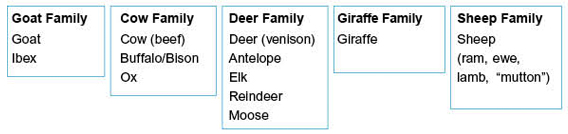
Kosher mammals are all cud-chewing, split-hooved animals (Leviticus/Vayikra 11:1-8 and Deuteronomy/Devarim 14:3-8). Included are both domestic ("beheimot"--goat, sheep, and cow families ) and wild ("chayot"--deer, giraffe, and wild goat and sheep families) mammals. There are two (sometimes) practical differences between the two groups:
- You may eat the cheilev (a type of fat) from a wild kosher mammal, and
- After slaughtering, you must cover the blood from a wild kosher mammal but not a domesticated kosher mammal.
Hooves
Q: How can you tell if an animal has split hooves?
A:
1) Split Hooves Must Be Hooves
Hooves must be made of hoof material--a hard substance similar to your fingernails—not fleshy feet.
2) Split Hooves Must Be Split
Hooves must be split all the way through from front to back.
Cud-Chewing
Q: How can you tell if an animal chews its cud?
A: Watch for the sliding ball.
When a cud-chewing animal starts to eat, you will see it bolting down its food into its first stomach, like a hungry 9th grade boy (much like humans racing to throw groceries into their shopping carts), in case a lion or bear is coming to eat him or her.
Next, it will find a safe place to more leisurely bring up its cud and chew its stash. During cud-chewing time, especially for goats (sheep are usually too woolly to make out shapes), you will distinctly see:
- Racketball shape popping up the goat's throat,
- Goat's cheeks ballooning out and its lower jaw chewing in a horizontal figure-eight pattern, and, a little later,
- Racketball shape sliding down the throat again.
You will soon see the shape of a new racketball pop up the throat.
By contrast, a non-kosher animal will chew slowly and well the first time—it will not have another chance to chew its food later, like the kosher animals do.
Imposters
Animals in the camel family (camel, llama, alpaca, vicunya, etc.) appear to have split hooves when seen from the front. These are actually just two long toenails in front of a padded, fleshy, incompletely split foot, which you can easily distinguish as a whole foot when looking from the back.
One non-kosher animal has great-looking split hooves but doesn't chew its cud—animals from the pig family.
Insight from Masechet Chullin
All kosher mammals inherently have horns; all non-kosher animals are hornless. Bottom line: If you find a horned animal, it's definitely kosher.
But horns are not a halachic requirement from the Torah like split hooves and cud chewing are, which is a good thing, since some breeds of goats, sheep, and cows are naturally “polled” (born hornless) or their horn buds were removed when they were young to prevent damage later.
Fowl
All Fowl That Have “Masoret” Are Inherently Kosher
Not everyone's agreed as to what the Torah means by a “netz” or a “yanshuf.” So when Leviticus/VaYikra 11:13-19 lists the 20 non-kosher flying species—allowing us to eat anything NOT on the list—we ignore the list and just eat what we know our ancestors traditionally ate as kosher. This tradition is known as masoret.
In the US, we eat all breeds of chickens and--in most circles--turkey, all breeds of goose except those whose beak is black (such as the Canadian goose) or whose beak does not go straight back to its forehead (like the Chinese goose), and Peking duck (we don't eat mallard or Muscovy ducks or their close relatives).
In Israel, additional birds eaten as kosher include mallard and Muscovy ducks, guinea fowl, Couternix quail, pigeons, and turtle doves.
Note Some Jewish families originating in Germany, Iran, and other places maintain their masoret on eating pheasant, and you may be able to receive masoret on various species from researchers such as “The Aris”--Dr. Ari Greenspan and Rabbi Dr. Ari Zivotofsky, both Jewish ritual slaughterers (shochtim) who have spent the last 20 years interviewing and videotaping elderly European and Sefardi immigrants to Israel as to what birds they ate as kosher in their home countries. You can google their work or read some of Dr. Zivotofsky's articles on www.kashrut.com.
Zivchei Cohen, a book written and published by a Jewish ritual slaughterer (shochet) in Italy, shows colored illustrations of 29 species known to be kosher, including peacock, pheasant, Couternix quail, mallard duck, and numerous songbirds. Maor L'Masechet Chullin U'Vechorot (vol. 2, Feldheim, pp. 29-33) reproduces these colorful illustrations and names each bird in five languages, noting that the 29 were listed to acquaint students of Jewish ritual slaughter (shechita) only with rarer birds' identities and that the well-known kosher species were not included in the 29!
Chazal noted that kosher birds share certain characteristics:
-
They sit on a branch with three toes in front and one in back. Non-kosher birds usually sit two and two, as they need equal strength on both sides of their feet for killing and carrying off food, except for:
- Owls, whose feet are flexible and can move their toes to the side, forward, or back, and
- Vultures, who need balance walking instead of gripping, since they walk on the ground to eat food that is already dead.
- They lay eggs that are not entirely round or oval but are, well, egg-shaped, with kad v'chad—a rounded end and a pointed end. Not all egg-shaped eggs are kosher, but all totally round eggs, if from fowl, are not kosher (fish eggs from kosher fish, which are perfectly round, are of course kosher). There are some eggs, including from doves, that seem perfectly oval but are actually kosher.
Fish
All Fish That Have Fins and Scales Are Inherently Kosher
This excludes most eels (some conger eels that have kosher scales are kosher!) and all shellfish, catfish, sharks, swordfish, sea urchins, jellyfish, sea slugs, and many other sea creatures.
In addition to commonly eaten kosher fish such as salmon and tuna, some unexpected fish are also kosher, including barracuda, goldfish, and many other pet and tropical fish.
Rule #5Grasshoppers
All other creatures, except the four kosher locusts, are not kosher.
Kosher from Kosher
Whatever Food Substances Come Out of a Kosher Animal Are Inherently Kosher…
except for some fats (cheilev), blood, and the sciatic nerve (gid ha'nashe).
Milk from a cow (a kosher animal) is kosher. Milk from a pig (a non-kosher animal) is not. An egg from a kosher bird is kosher; an egg from a non-kosher bird is not kosher.
Exception
Q: Since bees are not kosher, how can we eat honey?
A: Honey is not produced from bee parts, but rather from flower parts.
Rule #7
Animal Blood
May Not Be Eaten in Any Form.
Note Fish blood is not forbidden.
Preparing Kosher
Harvest and Kitchen
Plants
What To Check
- Remove bugs (see Why Bugs May Not Be Eaten)
- Select fruits and vegetables that have no harvest-related problems such as orla (and in Eretz Yisrael, kilayim, shmita, etc.); separate out teruma and ma'aser from any Israeli-grown produce that requires it (see Teruma/Ma'aser: Ownership: What Is Hefkeir Produce)
- Make sure that any liquid grape product to be handled by a non-Jew for a Jew has been cooked or pasteurized before being handled. Cooking turns the wine into an inferior product disqualified for use in idolatrous practices.
Animals
Mammals
Slaughter/Shechita
Kosher mammals must be slaughtered in the quickest and most humane manner possible, according to halacha. A highly trained ritual slaughterer (shochet) must perform the slaughtering (“shechita”). He checks the knife before the slaughtering to ensure there are no burrs to catch on the animal's throat. He says the blessing “al ha'shchita” and then cuts the windpipe and the esophagus as well as the neck arteries. After slaughtering, he checks the knife again for burrs (if he finds one, the animal is not kosher) and checks the animal's lungs to make sure the animal wasn't about to die of lung perforation in the near future.
Certain types of adhesions may be found on the animal's lungs. If they can be removed (by peeling) without perforating the lungs, the meat is kosher. If there are only small and easily removed lesions, the meat is glatt (“smooth”). If there are no lesions at all, the meat is classified as “Beit Yosef.”
Kosher lamb and goat are always glatt/chalak kosher.
Actually, there are 18 organic or physical defects that may make meat non-kosher but, as a practical matter, we only check for lesions in the lungs and also in the second stomach.
If the animal proves to have been healthy, it is sometimes hung upside down to allow the arterial blood to drain out. (It is possible to hang the animals before being slaughtered but this is not the usual method).
Skinning and Traiboring
The animal is skinned.
Next, the animal is traibored. Traiboring removes certain nerves, sinews, blood vessels, and fats that we don't eat, including the sciatic nerve damaged when our forefather Jacob wrestled with the angel at the Jabbok stream.
In the US, only the forequarters are traibored and eaten, and the hind portion is sold to the non-Jewish consumer. In Israel, the hind portion is traibored too and eaten as kosher.
May you traibor meat once it's cooked? And if not, how did Jews traibor more than 1 million Passover lamb offerings that had to be slaughtered and prepared between midday and evening (and it takes 2-3 hours to traibor one lamb!). The Jewish commentator The Raavad says the Passover lamb was traibored before roasting; Rambam disagrees, since the lamb had to be roasted whole. Rambam opines that the sinew, unlike fat, does not impart its flavor to the meat and that people would just traibor the Passover offering meat on their plates.
Removing Blood
The next steps involve removing blood (“kashering”) and can be done at the butcher's or at your home. The meat is cut, rinsed, soaked for at least 30 minutes, put on a slanted board to allow the blood to run off, and covered with kosher (a coarse) salt for one hour. After being rinsed three more times, the meat is now kashered.
Preparing the Liver
The liver is cut halfway through several times and covered with kosher salt top and bottom. You can oven broil the liver on a rack reserved for that purpose. The blood must be able to drain away from the liver
You can instead broil the liver over a fire outdoors. Grilling outside will give the liver a delicious smoky flavor that even children like--but do NOT allow the neighborhood cats to steal your livers off the grill!
Fowl
Covering Blood
Kosher fowl is slaughtered and, when it stops flapping, is usually hung upside down to allow the arterial blood to run out and onto the earth. Cover all the blood with dirt (a mitzva from the Torah--mitzva d'oraita) and say the blessing “al kisuy dam b'afar.”
Defeathering
Rinse with water and remove the feathers. Defeathering can take a while for chickens and up to two hours for one small duck, especially if you are saving the down!
Removing Internal Organs
Rinse the bird. Usually, a circle of flesh surrounding the anus is cut out. Start pulling out the digestive system. Recognizable items such as the liver, heart, and giblets will come out and eventually you will be able to stick in your hand and pull out the lungs. This is not as cold and unpleasant as it sounds because the bird will be warm for quite a while.
Salting
Once the bird is defeathered and the internal organs have been removed, rinse and salt with kosher salt inside and out and put it on a slanting board for an hour. Rinse three more times and cook!
Preparing the Giblets
Cut off the hard coating at one end of the giblets and rinse out the fine sand within. Remove the yellow internal lining. Salt and kasher with the rest of the bird.
Preparing the Liver
To kasher the liver, see Preparing the Liver, above, for meat liver.
Fish
Buying Fish
Kosher fish bought from a store in which non-kosher fish are also sold should have any cut surfaces scraped and should be rinsed before using. Ideally, the knife that cuts the fish should be washed with soap and water beforehand.
Grasshoppers
Chagav Grasshoppers
Not much preparation needed here. Many Yemenites just twist off their heads and eat. B'tei'avon!
Substances from Animals
Milk
Dairy must be kept separate from meat, with a separate set of pots, pans, servers, scrubbers, and dishpans each for dairy and meat. See Kashrut: Dairy/Meat Combinations.
Eggs
Eggs must be checked for blood spots. Throw out a fertilized egg with a blood spot. You may remove the blood in the white of the egg and eat the rest of an unfertilized egg, but the custom is to not eat the egg at all.
Unwanted Additives
Manufacturing Aids
In the US, food manufacturers are allowed to add “manufacturing aids”--even more than 1/60th of the volume of the other ingredients--without listing them. Some foods therefore need special supervision to ensure non-kosher substances have not been added.
Examples
- Kosher oils may be deodorized by heating them in vats that previously contained non-kosher oil, which renders the formerly kosher oil non-kosher. Or they may be put into tankers previously used for non-kosher liquids.
- Food colorings may come from the cochineal insect, which is non-kosher, and flavorings may be derived from the musk of non-kosher animals.
- Cheeses may have non-kosher rennet or pig milk added. Also, the rabbis of thousands of years ago made an injunction that even where the ingredients are kosher, cheese still requires kosher supervision.
- Maple syrup in the vat may be stirred with bacon (which is non-kosher) to reduce the froth produced by boiling.
- Candy may include non-kosher oil that is put into the molds so the candy does not stick.
- Kosher meat might not be kosher for Passover.
Transference of Taste (Ta'am)
Sometimes dairy will spatter onto a meat utensil, or someone will set a hot pot of kosher food into a non-kosher sink. Or someone will cut a lemon or onion with a dairy knife and then put the lemon into a pot used for meat. What happens next depends on whether the offending substance was:
- Charif (spicy/sour/strong) enough to transfer the taste to the new item.
- Hotter than yad soledet bo (too hot to hold your hand in it for a few seconds—about 120° F, or 49° C).
- More than 1/60th of the total volume.
Kitchen Set Up
A hungry Martian landing in a modern kosher kitchen must assume earthlings eat in binary: Ideally, two sinks. Two dish towels. Two sponges. Two dishpans. Two cutting boards. Even, if the owner is fortunate, two dishwashers.
And what about those strange markings on the pots, pans, and servers? Perhaps he'll find a bright splotch of red paint or an “F” (for fleishig--Yiddish for “meat”) lettered in nail polish on utensils in the left cabinets. Blue paint or nail polish, or an “M” (for milchig--Yiddish for milk) on utensils in the right cabinets. The plates, bowls, and silverware in left cabinets do not in any way match those in the right cabinets. Somewhere in a central cabinet, pots, pans, and servers are painted with a white dot, marked with a “P” for pareve, or left unmarked.
Opening the pantry, little symbols jump out from canned and packaged goods. Star-K, O-U, O-K, KOF K….. Only the dried beans and grains seem symbol-less. And the freezer? Well stocked but no frozen bacon, pepperoni pizza, and shellfish TV dinners.…
How do these people eat?
The Great Divide
Separating Dairy and Meat
Welcome to the world of dairy and meat. Most kashrut problems in the kitchen involve the transfer of milk or meat flavor to the other gender by means of heat or, less commonly, by hot/spiciness.
It's easy to be jealous of vegetarians, or people who only eat plants and dairy products or who only eat plants and meat products! They never confuse their pots and serving utensils or deal with spatters of hot dairy foods onto meat utensils or vice versa. Large institutions and kosher cafeterias, similarly, may not have these mix-ups, since they can usually devote a whole room to a dairy or a meat kitchen.
Here's how the rest of us live:
Countertops
If you can, designate some countertops for dairy and some for meat. This will help you stay organized spatially. If you have only one sink, you may need to use the counter to the left for one dishrack (dairy or meat) and the counter to the right for your other dishrack.
Some countertop materials, such as granite, can be kashered by pouring boiling water over them. This will make the counters kosher and pareve (neutral--not dairy or meat). Once you have kashered your counter(s), you will be able to set down hot utensils, pots, and pans directly onto the counter (dairy utensils on your designated dairy counter; meat utensils on your designated meat counter).
If your countertop is not kosher or kasherable, you will need to cover the countertop before setting down hot (above 120° F) utensils, pots, and pans. Trivets work fine but so does a simple piece of corrugated cardboard in a pinch.
Dishes and Flatware
If feasible, select different patterns of dishes and flatware for dairy and meat so you can tell them apart. It is helpful to store the dairy and meat dishes in separate locations, preferably close to the counter of its gender. Porous dishes (stoneware, china, ...) cannot be kashered once used for hot non-kosher food and cannot be changed from one gender to the other. Metal dishes generally can be kashered. Glass only assumes a gender if it is placed directly on a fire or other heat source (to at least boiling temperature) or into a hot oven, so even if you pour boiling water or hot food into a glass bowl, such as hot pasta, and add cheese or other dairy food, the bowl remains pareve (or whichever gender it was previously).
Sinks and Dishracks
If you don't have two sinks--one for dairy and one for meat--and must use the same sink for both, try to choose different colors for your dairy, meat, and pareve dishpans, dishracks, and sponges/scrubbers (or sponge holders). If not, distinguish your dairy dishpans, dishracks, and sponges/scrubbers (or sponge holders) from your meat ones by placing them on opposite sides of the sink. Neutral, or pareve, dishes/cookware require a third sponge and dishpan. In a pinch, you can wash dishes, pots, and utensils by holding them in the air or placing them on a counter (whether either kashered or not) next to the sink as long as the dishware, pots, etc., do not reach 120° F.
Drawers
You can designate one drawer for dairy flatware and a second drawer for meat (and a third drawer for pareve). Color-coding or purchasing “dairy” and “meat” stickers to place on the outsides of cabinets and drawers can be especially helpful if anyone else will be cooking/washing dishes in your house and doesn't know your kitchen well.
Cooking Utensils/Food Processors
Distinguish your cooking utensils (your choice of colors) for dairy, meat, or pareve by using paint or nail polish, using different patterns, or even different shapes (one person uses round baking dishes for dairy and rectangular ones for meat!). If you lack drawer space, hang utensils from the wall or overhead rack or put them on your counter in jars color-coded for dairy, meat, or pareve. In a pinch, colored electrical tape can be used temporarily to mark dairy or meat servers or serving pieces (until it falls off during washing or turns black in the oven…).
You will only need one blender, blending stick, bread machine, mixer, food processor, etc., if you always keep them pareve. Otherwise, you may need duplicates of these items. Color-code them as well.
Stove Burners
To kasher a non-kosher stove burner, clean off any hard deposits on the grate, cover the burner with a sheet of metal (to hold the heat on the grate), and heat it full-blast for 45 minutes. (See halachot below for kashering burners by putting them in the oven.)
Stovetop
A stainless steel stovetop can be kashered, but a ceramic one (due to porousness) might not be kasherable-consult a rabbi. When cooking, place an appropriate spoon rest or bowl nearby (for dairy or meat, depending on what you are cooking) to hold your hot stirring spoon or spatula. This way, you won't need to set down your hot stirring utensil onto a non-kosher countertop or stovetop, or place a hot dairy stirrer where you previously set down a hot meat spatula.
Oven
You can kasher a non-kosher oven by cleaning off any accumulation of old food (whether burned on or not, it must be removed) and turning up the oven full blast for 40 minutes. You may use the same oven for dairy and meat foods if you always keep either the dairy or meat covered. Consider the oven to be one gender and always cover liquid foods of the opposite gender (dry foods do not require a cover).
Cutting Board
If you only have one cutting board for fruits and vegetables and one knife, you may want to keep them pareve. The main kosher problems with knives and cutting boards happen when cutting a fruit or vegetable with a strong-spicy taste that can transfer the milk or meat status of one utensil or food to another. Such items are garlic, lemon, onion, and sour apples, and sour grapefruits.
Examples
- Garlic was chopped with meat knife on a dairy cutting board (rendering the garlic, the knife, and cutting board non-kosher), or
- Onions cut with a dairy knife were tossed into a boiling meat pot (rendering the pot and contents non-kosher unless the onions were less than 1/60th the volume of the pot's food).
TABLE'S SET
Glasses, washed, can be used for a dairy or meat meal. You can use the same salt and pepper shakers and clean glasses for dairy and meat; however, it is recommended to use separate salt and pepper shakers since you might have food of one gender on your hands when you use the shakers of the opposite gender. If you typically use a table for serving either dairy or meat, and want to serve the opposite without switching tablecloths, lift the tablecloth and use the original table surface or cover the tablecloth with placemats. If one person wants to eat dairy and another wants to eat meat at the same time on the same table, place a reminder to remind them not to mix the foods (different placemats or tablecloths, physical barrier between the people's dishes, etc.).
COOKING FOR RELIGIOUS JEWISH FRIENDS
Let's say you don't keep kosher and want to have your kosher-observant friend over. What to serve?
As long as your utensils are clean, you chose kosher foods (see Going Shopping, below) or fresh fruits and vegetables, nothing gets 120° F or above, there is no involvement of anything spicy (charif), and you don't mix dairy and meat (don't offer a kosher bologna sandwich with kosher Swiss cheese!), everything should be OK. Some people will prefer if you serve them using disposable plates, bowls, flatware, and cups; if you are Jewish, you should only serve on disposables. Some will prefer to be in the kitchen during food preparation. Don't be offended; it's hard to keep track of everything to remember even in a kitchen set up for being kosher!
You might want to keep the wrappers or containers from any processed food so that the kosher guest can see what you actually are serving and check for the ingredients or for a kosher supervision symbol.
GOING SHOPPING
Major towns usually have at least one kosher supermarket, but you can find plenty of kosher food in regular supermarkets too. (Even in Salt Lake City, home of the Mormons, a major supermarket chain sells Empire Kosher Chickens!) Here are some tips:
- You may consider all fresh and uncut fruits and vegetables to be kosher. Sharp-flavored fruits and vegetables such as garlic, when cut, must be cut with a kosher utensil.
- Look for a kosher symbol (“hechsher”) on prepared foods (except those foods that do not need a hechsher—see When Hechsher Needed and When Hechsher NOT Needed).
For more information on kosher symbols and on what goes into certifying a prepared food as kosher, see this link: http://kosherquest.org/symbols.php
WHY EAT ONLY KOSHER?
The basic reason that Jews only eat kosher food is because God commanded us to do so. There are many explanations of how eating kosher benefits us. One approach is that kosher food enhances the spiritual well being of the Jewish people. That holiness is blocked when we eat non-kosher.
While kosher food raises us up spiritually, we raise it up too. When we say the correct blessing before or after we eat, we acknowledge that God is the food's true source. When we use food's resulting health and strength to perform God's commandments, we reunite our food and ourselves with our higher purposes, “rectifying the world.” That brings spiritual and physical blessing down to us and to the world.
You don't want a rapacious spirit? Don't eat predators. You don't want to think like a bottom-feeder? Don't eat scavengers—whether catfish or vultures or pigs—or reptiles, amphibians, or bugs (except kosher grasshoppers!). You don't want to be callous? Don't eat the life-blood of a bird or mammal—or even the bloodspot of an egg. You don't want to be cruel? Make sure the animals you eat were slaughtered quickly and humanely. Don't want to separate yourself from worshipping the Only One? Don't drink wine or grape juice that could have been used for idol worship.
And non-Jews? Shouldn't they keep kosher too?
Non-Jews must keep only one kosher law--aver min ha'chai. This means non-Jews, like Jews, may not cut off and eat the limb of a live animal.
We can come up with numerous explanations for why keeping kosher is healthier, more pleasant, more logical, or more spiritual than eating non-kosher. But the bottom line is, we do it because God says to, we are here to serve Him, and we trust that God wants what is best for us!
The Three Discussion Points
The most important part of the seder is discussing:
- Passover offering (Pesach),
- Unleavened bread (matza), and
- Bitter herbs (maror).
Children at the Seder
Children are an integral part of the seder. We try to get children to ask questions and then we teach them the answers. The Torah says to do this!
Acknowledging God's Miracles
We acknowledge God's miracles in sending the plagues against the Egyptians and their gods and in taking the Children of Israel out of slavery and Egypt.
Telling Our History
We tell our history beginning with Jacob (Yaakov) and Laban (Lavan) and on to slavery and, finally, to achieving freedom.
- “Ketiva V'Chatima Tova”
Until: Eve of (erev) Rosh Hashana (when the holiday begins).
- “L'Shana Tova Tikateiv V'Tichateim”
Until: Musaf of the first day of Rosh Hashana.
- “Gmar Chatima Tova”
Until: End of Yom Kippur.
- “Gmar Tov”
Until: Musaf Hoshana Rabba.
Halacha ("The Way To Go" or "Way to Walk") guides proper Jewish behavior in all aspects of life, each day of our lives--not just in civil laws or court situations. Halacha teaches us how to behave with our families, relatives, and strangers as well as how to fulfill our religious requirements between ourselves and God.
To fulfill our role as a holy people, we imitate God's actions. Examples are visiting the sick, welcoming guests, giving charity, refraining from creative activity on Shabbat, and promoting peace between husband and wife (shalom bayit).
The true reason for following halacha is because God commanded us to do so. We observe halacha to please our Creator and to become spiritually close to Him by doing His will and imitating His actions.
Like the word for the whole body of Jewish "laws," each rule of how to act is called a halacha (plural, halachot).
Where Do Halachot Come From?
Although you will find halachot on this site that were born only a few days or a few decades ago, the body of halacha has been around since before creation. "God looked into the Torah and created the world," says the Zohar, and so we find the Patriarchs followed halacha even before that great law book, the Torah, was given on Mount Sinai four centuries later.
Many halachot are specified in the Written Torah (Jewish Bible). These halachot correspond to fuller and more detailed halachot given orally (Oral Torah) to Moses on Mount Sinai to explain the Written Torah that he received at the same time. Many halachot could not be understood from the Written Torah without the Oral Law (for example, what should be written on a mezuza scroll?) and many common practices such as making kiddush or what tefilin should look like are to be found nowhere in the Written Torah.
Since the Torah applies to all generations, the Torah specifies that there be wise and learned people to decide how to apply halacha to the situations of the day. Halachot can be found in sourcebooks such as the Mishna, Gemara, their commentaries, Shulchan Aruch, Mishna Berura, and responsa (questions and answers originally sent by letter and now, occasionally, by email or SMS!) of later rabbis.
Sometimes a custom becomes a halacha, sometimes not. For example, the original halacha for tzitzit was that a Jewish man who wears a four-cornered garment must have tzitziyot on each corner. The custom, which has become universally accepted and now has the force of halacha, is that Jewish men wear a four-cornered garment in order to be able to fulfill the commandment of wearing tzitziyot. An example of a custom that did not become a halacha is that some men and boys wear their tzitziyot outside of their shirts and pants.
Levels of Halachot
In halacha, there are three levels of what to follow or observe. They are differentiated on this website by the following terms:- “Must”: Halachot that are generally non-negotiable except in extreme situations;
- “Should”: Customs that have been accepted by the entire Jewish world (or major segments of it) and that may be overridden when necessary, sometimes even if not extreme circumstances; and
- “Non-Binding Custom”: Customs that are not universally followed and that do not need to be followed except by people who have the tradition to do so.